
Sponsored ContentPartner ContentTue 26 May 26
Why Property Developers are Embracing Social Procurement

For eight years, Social Traders has tracked what Australian businesses and governments spend with certified social enterprises. Property and commercial development were there from the start, and the 2025 financial year numbers show exactly why this sector’s lead matters more than ever.
Around $304 million was spent with certified social enterprises in the 2025 financial year alone, which is an 18 per cent increase on the 2024 financial year and the highest single-year total on record.
The cumulative eight-year figure is now more than $1.4 billion, with a 35 per cent average annual growth rate that has held steady across the period.
Most new initiatives see momentum dip over time. Social procurement continues to grow.
A strategic lever, not a reporting exercise
Property developers and commercial builders procure at scale. What they spend can do double duty.
Social enterprises employ people who face the greatest barriers to work: refugees, people living with disability and those recovering from long-term unemployment. They supply goods and services across building trades, landscaping, design and facilities management which are all categories that sit squarely within the property sector’s existing spend.
By embedding social enterprises into a project supply chain, a developer or builder gets the same quality goods and services it would procure anyway, while generating social and environmental value in the same transaction.
Construction and infrastructure organisations make up the largest cohort of Social Traders members, and they are accelerating their social performance without mandates requiring it.
Across eight years, Social Traders member organisations have contributed to 13,383 jobs for people who face barriers to employment, one million training hours and 68,050 tonnes of waste diverted from landfill.
In the 2025 financial year, spend directed to marginalised women grew 56 per cent to $47.1 million, while spend supporting Aboriginal and Torres Strait Islander communities grew 69 per cent to $18.8 million.
The categories are shifting
The categories historically associated with social procurement were catering and cleaning. The growth is now in engineering, technology, architecture, planning, and building trades.
Building trades, repairs and maintenance reached $62 million in the 2025 financial year, up from $1.8 million five years ago. Architecture, planning and design grew from $80,000 to $2.1 million in the same period.
Certified social enterprises are no longer providers of ancillary services, they are competing and winning on the same contracts that appear in every development project.
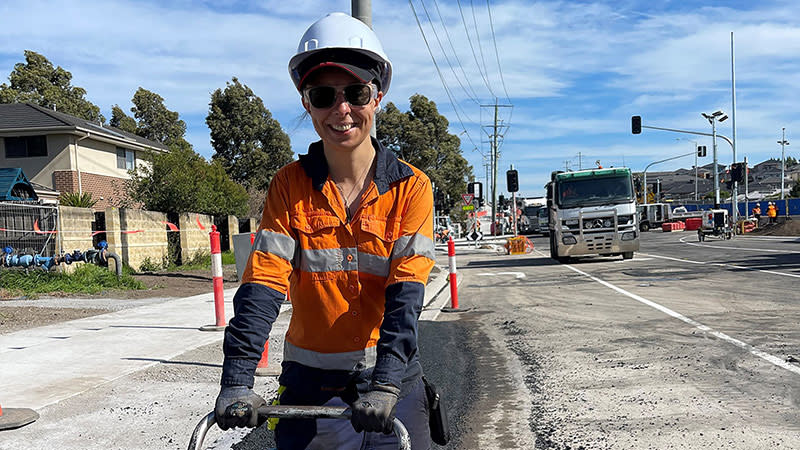
When Southern Program Alliance awarded a $3.8-million landscaping package to social enterprise Navaroo on the Parkdale Level Crossing Removal Project, five skilled migrants gained nearly 4000 hours of meaningful work and Navaroo’s own supply chain spend included $224,000 with other social enterprises.
That project has since won the 2025 National Social Procurement Impact Partnership Game Changer Award. It is one example of what is becoming standard practice among leading property and construction organisations.
The business case has shifted too
In 2020, 54 per cent of new Social Traders members cited compliance as their primary reason for joining. By 2025, that figure has dropped to 45 per cent. ESG and sustainability goals now account for 38 per cent of new member motivations and the gap between the two has narrowed from 16 percentage points to seven in five years.
For the property sector, where investor mandates, green star ratings and community benefit requirements are increasingly standard, this is a meaningful shift.
Organisations that can demonstrate credible, measurable social outcomes are gaining competitive advantage: winning tenders, attracting talent, strengthening relationships with government clients, and mitigating supply chain risk.

Property companies such as Lendlease, Mirvac, Charter Hall, and Built are among those already leading. CPB Contractors topped the 2025 financial year rankings with $34.2 million directed to certified social enterprises.
Social Traders chief executive Tara Anderson said “at 35 per cent average annual growth over eight years is not a trend—it’s a structural shift in how leading organisations think about their supply chains as a social performance driver”.
“The businesses experiencing that growth aren’t doing it as a tick box,” he said. “They’re doing it because it’s delivering real value, commercially and socially.”
The property sector built this movement. Now it needs to hold the lead.
Other sectors are closing the gap. Banking, consulting, energy, education and transport have all grown their membership with Social Traders. The competitive differentiation that property organisations once held is narrowing. Now is the time to deepen the advantage, not rest on it.
Social Traders membership gives property and commercial development organisations access to more than 760 certified social enterprises across every major procurement category, plus a framework for tracking and reporting social spend. Every certified supplier has been independently assessed against international standards and rigorous commercial and social criteria.
“Australia is moving faster on this than anywhere else in the world,” Anderson said.
“We have the certified supplier base, the member network and eight years of data to prove it works. The question for any organisation now isn’t whether to embed social performance; it’s how quickly they can get moving.”
The time to act is now. Join the leaders of your industry with Social Traders.
The Urban Developer is proud to partner with Social Traders to deliver this article to you. In doing so, we can continue to publish our daily news, information, insights and opinion to you, our valued readers.





