
ExclusiveChris ThomsonMon 06 Jul 26
Lessons Emerge as Sydney Aerotropolis Takes Planned Cities to New Plane
TUD+ MEMBER CONTENT
Bradfield, the heart of Western Sydney’s emerging Aerotropolis, will be Australia’s newest city, but it draws on nuanced knowledge of place that goes back centuries and in some cases millennia.
Bradfield Development Authority acting chief executive Natalie Camilleri says that building a city for the future is a rare opportunity.
“We are committed to really creating something uniquely suited to Western Sydney and a key part of that is around the open space and part of that is around a central structuring device for the city,” she tells The Urban Developer.
“So, quite excitingly, we have a Metro line through the site underground and ... when you come out of the Metro, you will be able to walk into a 2ha park right in the centre of the city.”
The design of that park—like the watercolour renderings that Marion Mahony and Walter Burley Griffin submitted for a 3000ha Australian national capital in 1911—was conceived via a competition won in 2023 by a team led by Aspect Studios.
“And then beyond that ... we have about 36ha of open space, which is about a third of the site, down to the south of the master plan, which [doubles as] our integrated regional stormwater system,” Camilleri says.
She says the open space will have “a sense of green, but also a sense of blue” as the BDA is keen to keep water in the landscape.
“What will be different to [the greenbelts and parklands of Australia’s other planned cities] Canberra and Adelaide, is that the presence of water will largely be ephemeral,” she says.
“There will be water there when there are heavy rains and we will store as much water as we possibly can, but there will be periods of dry as happens in creek lines.
“We do have a plan for what we would call an offline swimming area so that we can retain an appropriate level of water quality for people to go out and enjoy an outdoor water experience in a safe environment.”
Planned for a 114ha site immediately south of the new Nancy-Bird Walton international airport—where commercial flights will commence this month and passenger flights in October—Bradfield will have 10,000 homes built for more than 15,000 residents over the next 30 years.
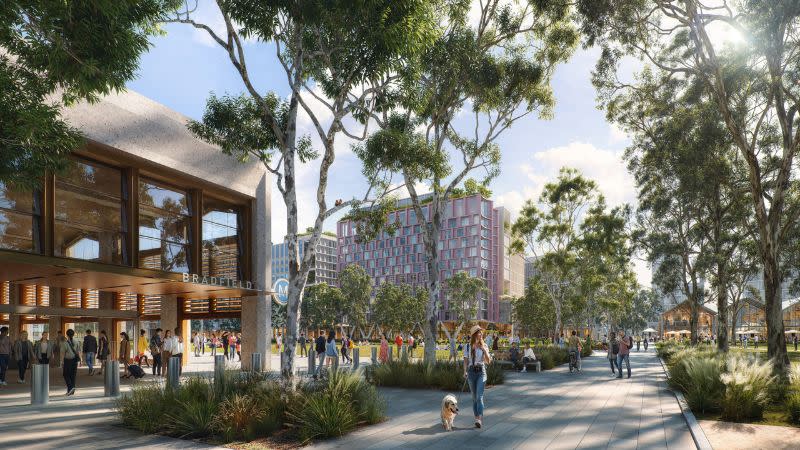
University of New South Wales School of Built Environment emeritus professor James Weirick says Bradfield’s green network is analogous to the extensive central parklands of Adelaide and greenbelts of its second planned city, Canberra.
Grids locked into city designs
Weirick says another theme that Australia’s latest planned city shares with its predecessors is grids.
“For a long time in the mid-20th century, under the car-based idea, grid planning was out and four-way intersections were considered to be dangerous by traffic engineers,” he says.
“But the grids came back.
“Of course, there’s the grid in [Colonel William] Light’s 1837 plan for Adelaide and there are grids in Griffin’s plan, although when you look at it you see the polygonal aspects of them, but within those polygons there’s a predominance of grids.”
Weirick says that Bradfield has “a whole series of grids” offset from a spine road that follows a ridgeline between the city’s two main creeks.
“So, it’s not a US city where the grid is laid out everywhere; it is inflected within the undulations of the shale landscape,” he says.
“Nevertheless, the everyday experience of the city will be a series of predominantly square grids.”
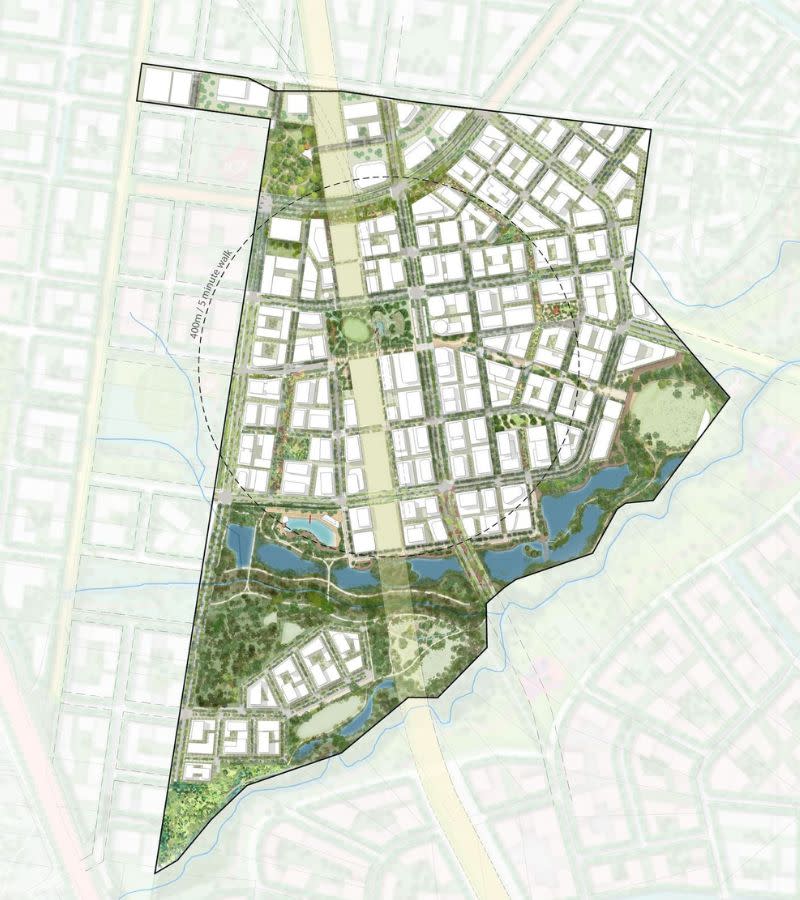
Weirick says a third thing the three planned cities have in common is government-owned land.
“Now, of course, Adelaide became government owned by stealing it from the original owners,” he says.
“And Canberra was, in quite spectacular fashion, purchased at rural land prices.
“In the very beginnings of the Commonwealth parliament, there was an amazingly far-sighted decision, and various sides of politics in that era supported that idea; the public ownership of land makes it very much easier to plan, design, and release land and so forth.”
In 2021, the NSW Government bought the 114ha Bradfield site from the Commonwealth for $322 million.
Weirick says the decision to progress the city’s first 1400 homes, a hotel, shops and a university campus as a joint venture between the BDA and multinational developer Plenary (which was contacted for comment for this story) minimises economic risk and the flow-on risk of compromising the city’s planning.
“If the risk is spread between the BDA and Plenary as a joint public private partnership, that means, presumably, the development scale will be consistent with the masterplan and not be changing all the time in return for paying for the costs of development,” he says of the billion-dollar project for Bradfield’s first superlot.
Aerotropolis on another plane
An area the BDA is focusing on that was not a priority of government agencies in the days of Colonel Light and the Griffins is designing with and for the area’s traditional custodians.
“The Griffins were highly critical of the treatment of Aboriginal people in Australia and Griffin did work with Aboriginal people on his scheme for Port Stevens [New South Wales, which was never built],” Weirick says.
“But, this idea of Country has been promoted, certainly in New South Wales, by the government architect and it came out of the emergence of First Nations professionals, the architects, building careers, which is a recent phenomenon.
“And a few, really effective, First Nations architects began to really influence the whole thinking.”
Camilleri says the Bradfield masterplan was built around designing with country, and evidence of that is Bradfield’s first building, which is yet to be named. Now complete, the building was designed by Hassell, which was contacted for comment for this story.
“Also, a lot of choices that we’re making in the delivery of the landscape and the built form and features; there’s an incredible focus on the way that is done with First Nations people,” she says.
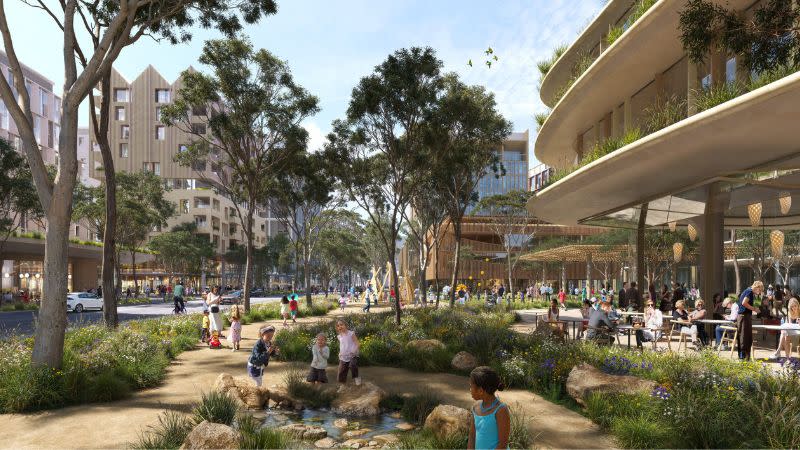
“There’s a great degree of inclusion in terms of First Nations design expertise, but also traditional custodians in that process and a really strong commitment to procurement of Aboriginal businesses in the delivery.
“We’re trying to really establish this engrained sense such that there is an absolute sense of welcoming and inclusion, which we believe will be unique in Australia and that’s where we indeed should be given that it’s 2026.”
TUD+ Member Only Content
Get the full story.
Become a TUD+ member to unlock this article, plus exclusive analysis and member-only events and webinars.
You'll return here after signing up.





