
ResidentialLindsay SaundersThu 14 May 26
Home Loan Commitments Slide as Rate Hikes Bite

New home loan commitments in Australia fell in the March quarter as higher borrowing costs and softer buyer demand weighed on housing finance activity across both owner-occupier and investor segments.
The latest lending indicators from the Australian Bureau of Statistics showed a decline in the number and value of new housing loans after stronger growth through the second half of 2025.
ABS head of finance statistics Mish Tan said falls were recorded across all borrower types during quarter after strong growth throughout 2025 and cash rate rises in February and March.
“Despite this quarter’s fall, lending activity remains at high levels, with total new home loans 8.6 per cent higher than a year ago,” she said
The value of total new loans also fell 3.8 per cent, or down $4.0 billion to $103.0 billion in the March quarter, but was 18.5 per cent higher through the year.
“Annual growth in the value of new lending has continued to outpace growth in the number of loans, a trend we have seen since December quarter of 2023.”
“The average home loan size is now 9 per cent higher than a year ago at $724,415.
“This is consistent with rising property prices, with the strongest growth in Western Australia, Queensland and South Australia.”
Number of new loan commitments for homes, March 2026
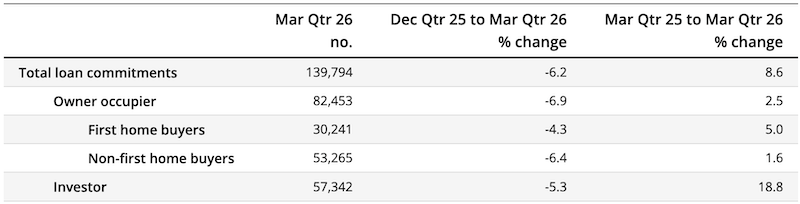
Owner-occupier lending weakened during the quarter, with first-home buyer activity also easing as affordability pressures and elevated mortgage repayments continued to constrain borrowing capacity.
Investor lending remained comparatively resilient despite signs that rising interest rates and tighter lending conditions were beginning to slow activity in parts of the market.
The slowdown in finance commitments comes as housing markets in Sydney and Melbourne lose momentum amid weaker auction clearance rates and growing levels of advertised supply.
Economists said the March quarter figures reflected increasing caution among borrowers following a period of rapid growth in housing credit and rising average loan sizes.
The figures were released as the Reserve Bank continues to battle inflation pressures, with markets anticipating further pressure on household borrowing conditions this year.





