
Quality Over Quantity: Solving Sydney’s Unit Density Dilemma

“As an industry, I think we’ll be judged on this era.”
PBD Architects managing director Paul Buljevic believes this is a defining moment.
New South Wales planning reforms represent an unprecedented government initiative to solve a housing shortage, creating transformational opportunities for architecture and development.
Low and Mid-Rise Housing (LMR), Transit Oriented Development (TOD) and Housing Diversity Areas (HDA) initiatives allow more density on sites once restricted, unlocking major uplift opportunities.
Buljevic said the industry needs to be conscious of maintaining design standards as these reforms will reshape Sydney’s residential landscape for decades.
While some may see these reforms as restrictive, Buljevic sees opportunity, with projects that balance density with good design shaping how communities will live and thrive.
“Some parts of Sydney will have an immediate increase in supply in a short timeframe, creating more choice,” Buljevic told The Urban Developer.
“Purchasers and end users will be very conscious of what is good design—what achieves good amenity, pragmatic planning and quality level of finish.”
PBD Architects’ philosophy centres on design excellence across all projects, regardless of location or price point.
Good design can happen anywhere, not just in affluent areas, Buljevic says. The practice’s focus is on pragmatic design that balances how people live, work and play no matter where they live.
Balancing yield with design excellence
To navigate this challenge, PBD Architects has developed a framework balancing three competing risks.
First is feasibility risk, ensuring yield and efficiency targets are met.
Second is planning risk, achieving approval within regulatory controls.
Third is design risk, protecting design quality within these constraints.
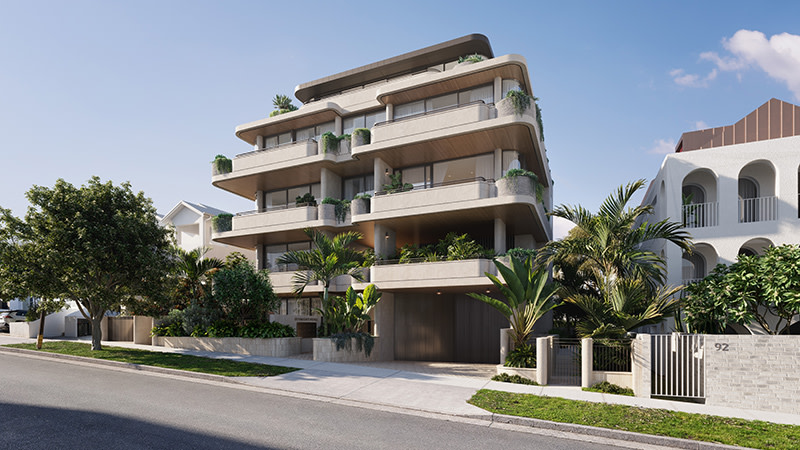
The firm focuses on early planning to achieve full potential density and maximise tenant amenities while respecting neighbourhood context.
“These controls are forcing you to think outside the box,” Buljevic said. “So, for us, we treat every project almost like a design competition.
“We go through those stages of investigating the brief, the opportunities and constraints and work with all those factors to get the best outcome for developers and residents.”
Density uplift without compromise
A project at 88-90 Ramsgate Avenue in Bondi for HSN demonstrates this approach.
The project achieved 30 per cent housing uplift while reducing scaling along the street frontage more akin to previous controls, with upper levels stepping back to preserve character and enhance amenity for upper level apartments.
“We didn’t have to compromise the amenity of the occupants to achieve that extra density,” Buljevic said.
Creating distinction through design excellence
As supply rises across Sydney, developers can differentiate projects through core identity and smart apartment mix. The challenge is to maintain quality through efficient design and maintaining functional layout that benefits how people live.
“You can save money by being efficient—optimising the structural grid when designing apartment layout, balancing services, minimising transfers,” Buljevic said.
“Then you invest those savings where it benefits the occupants.”
The practice maintains that good design principles remain constant across all suburbs and price points.
Core planning principles—orientation, solar access, furnishability and spatial proportion—apply universally, whether harbour-front developments or suburban sites.
Developers evaluating sites under the new rules should consider factors beyond uplift scenarios, with site selection based on outlook, proximity to amenities, orientation and design potential becoming critical differentiators.
“It’s about being at the forefront and delivering quality,” Buljevic said. “When competition is there and increased supply is there, you’ll need to be more competitive in some way.
“We can see the change in landscape with some developers understanding how to create an edge or how to deliver really high quality housing and they’ll focus on creating better products through design excellence and pragmatic planning that transforms how communities live.”
The Urban Developer is proud to partner with PBD Architects to deliver this article to you. In doing so, we can continue to publish our daily news, information, insights and opinion to you, our valued readers.

Iran Strikes Stir Uncertainty Over Oil, Construction Costs

Melbourne’s Housing Market Stronger Than Headlines Suggest

AI is Hotel’s New Frontier as Ultra Luxe Leads Way: Paul Salter

SEQ Grapples with High Risk, High Reward in Run Up to Olympics


